Better AI Does Not Eliminate Ambiguity: It Makes It Executable Faster
TokenShift Executive Note
The comforting assumption is this: as models improve, engineering rigour will matter less. You describe the intent in two sentences, the agent fills in the rest, and iteration corrects the course.
The opposite is happening.
A technical report published on arXiv in May 2026 by Vu Hung Nguyen and Thanh Nguyen formalises what many teams are observing without naming it: agentic speed does not eliminate engineering discipline; it shifts it upstream, into specification precision, explicit checkpoints and auditable traceability. Put differently: whatever you failed to formulate, the agent will execute anyway.
The ambiguity tax
The authors give this mechanism a name: the ambiguity tax. The less clear the intent, the higher the probability of agent error—and not in a linear way. The formula they propose is an observed pattern, not a measured law; we cite it for what it reveals, not for its precision.
What it reveals is simple. A vague requirement used to be inexpensive. It triggered a corridor conversation, a ticket, a three-day arbitration. Human slowness constrained ambiguity. An agent does not slow down. It propagates the interpretation it has retained across every file, every edge case, every branch—in a single pass and within hours. The defect does not remain local: it becomes systemic before the first review.
The evidence-backed part of the case lies elsewhere, and it is even more sobering. An empirical study accepted at the MSR 2026 conference (Hao He, Courtney Miller, Shyam Agarwal, Christian Kästner and Bogdan Vasilescu, arXiv, November 2025) compares open-source projects that adopted an agentic coding assistant with a matched control group. The result: the velocity gain is statistically significant, substantial, and temporary. The rise in static-analysis warnings and code complexity, meanwhile, is substantial and persistent. And those latter two factors ultimately explain the slowdown in velocity. The authors conclude that quality assurance becomes the bottleneck.
Translated for an executive committee: speed without discipline does not create performance; it creates debt, and that debt takes back the speed it lent. Automating a flawed workflow generally produces a faster flawed workflow.
The governance question has changed its verb
For thirty years, the audit question could be expressed in four words: who wrote this? One author, peer review, an audit trail. The name at the bottom of the deliverable identified both competence and accountability.
That question no longer bites. When an agentic system produces a module, a credit memo, a response to a regulator or an insurance claim file, the right question becomes threefold: who specified it, who verified it, who approved its release to production?
This is not a semantic nuance; it is a shift in accountability. And case law did not wait for doctrine. In 2024, Air Canada was ordered to pay approximately CAD 812 because its conversational agent had invented a refund policy: the company is liable for its AI’s outputs, not the model provider. In October 2025, Deloitte Australia refunded approximately AUD 97,000 for a government report containing hallucinated citations. In both cases, no one disputes that the machine produced the text. What proved costly was the absence of someone who had verified it and taken responsibility for it.
The three signatures
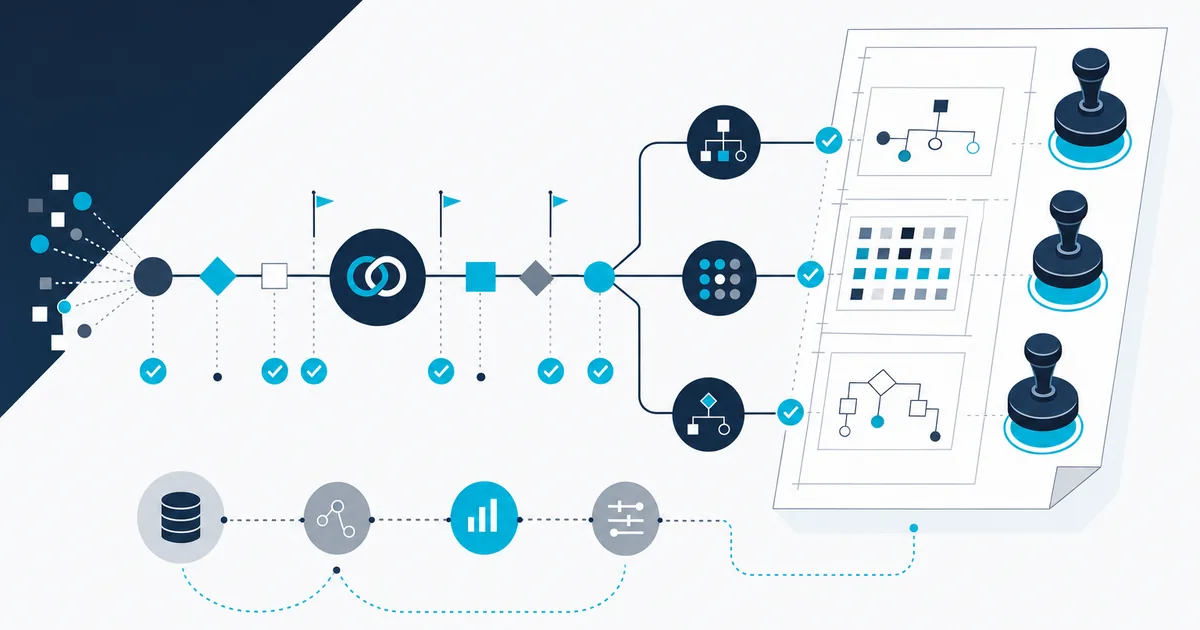
We call this the three signatures. Specify, verify, approve: three acts, three named responsibilities, never the same person.
First signature: specify. Someone owns the intent and is accountable for its precision. This role exists almost nowhere in current organisation charts. It is not about writing more documentation; it is about writing an intent that holds up in execution.
Second signature: verify. The person who produces is never the person who verifies. This rule has always applied to humans; it now applies to agents. The May 2026 report takes the precaution one step further: the control authority must remain outside the model family that produced or repaired the tests, unless redundancy has been explicitly designed. A marker grading their own paper does not become reliable simply because they are fast.
Third signature: approve. Release authorisation remains human, and it is named. The authors, although supportive of agents, do not compromise on this point: synthesis may be delegated; delivery authority may not.
This framework is more demanding than generic human in the loop, and that is precisely its value. Human in the loop states that a human is somewhere in the chain. It says neither what authority that person holds nor, crucially, what authority they must not hold. The three signatures, by contrast, can be checked in a log: three distinct identities, or a control failure.
An executable specification can be measured
The practical question remains: how do you recognise an intent precise enough to entrust to an agentic system? The report proposes four dimensions, and they are directly auditable.
- Completeness: edge cases and failure modes are written down, not implied.
- Consistency: requirements do not contradict one another.
- Unambiguity: each requirement allows only one stable interpretation.
- Verifiability: each requirement is tied to a test or an objective criterion.
The fourth is the one almost always missing. An unverifiable requirement is not a requirement; it is an intention. It works very well in committee and very poorly in production.
On the same Tuesday morning, two European insurers launch the same claims-handling agent. The first has written thirty pages of context and two acceptance criteria. The second has written eight pages, forty testable acceptance criteria and an explicit list of what the agent is not allowed to decide. Six weeks later, the first discovers inconsistent handling of subrogation cases during testing, propagated everywhere. The second stopped the same defect on day three, through a failing test. These are not two different models. They are the same technology, with and without the first signature.
Your agents’ bottleneck is not model power. It is the precision of what you asked them to do, and the name of the person who signed off on sending it into production.
Five questions for your next executive committee
- For our most advanced AI deployment, who is explicitly accountable for the specification, and where is it documented?
- How many of our requirements are tied to a test or objective criterion, and how many remain intentions?
- Is the person who verifies independent from the person who produces, including when both are agents?
- Who holds release authorisation, and does that authorisation leave a named audit trail?
- If a regulator or client asked us tomorrow who specified, verified and approved a given output, how long would it take us to answer?
If the fifth question requires more than a day’s work, your model is not the issue.
The real task for companies in 2026 is not securing more powerful models. They will arrive anyway, and faster than your budget cycles. The task is having workflows specified, verifiable and governed well enough to be entrusted to agentic systems. That is precisely the difference between an impressive pilot and a production deployment you can stand behind. It is what we build with our clients, and what we have implemented for our own products, starting with RegRadar by TokenShift.
A candid question: in your organisation, could you name today the three signatures for your most critical AI deployment?
We are publishing this series throughout the summer, in preparation for our September executive-committee campaign. Follow the Page for more.
Sources:
- Vu Hung Nguyen and Thanh Nguyen, SDAD: Spec-Driven Agentic Development for the AI-Native SDLC, arXiv technical report, May 2026.
- Hao He, Courtney Miller, Shyam Agarwal, Christian Kästner, Bogdan Vasilescu, Speed at the Cost of Quality: How Cursor AI Increases Short-Term Velocity and Long-Term Complexity in Open-Source Projects, MSR 2026 (arXiv, November 2025).
- British Columbia Civil Resolution Tribunal decision against Air Canada, 2024.
- Fortune, 7 October 2025, Deloitte Australia’s refund to the Australian government.
#AIGovernance #EnterpriseAI #ExecutiveCommittee #ProductionDeployment