Open reference framework — part 2
The 12 controls of outsourced AI
Account opening with KYC, content production, back-office operations: when a process is outsourced, AI can enter through the provider's margin, undeclared. Outsourcing the work does not transfer your own obligations: to your regulator, your customers and your brand, you still answer for what is done in your name. The provider answering too, on its side, does not discharge you.
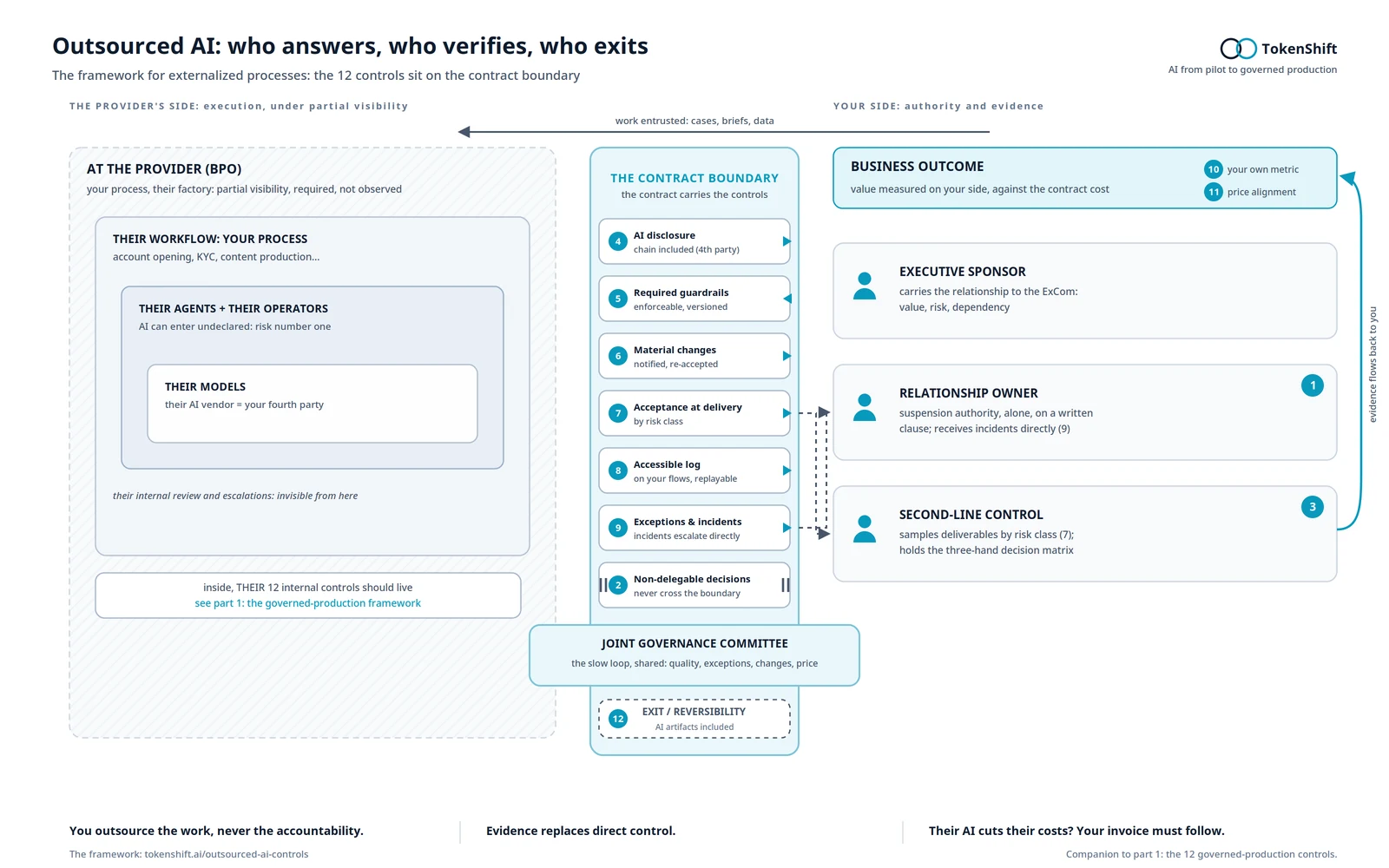
Part 2 of the framework states the 12 controls of an outsourced process where AI operates. They no longer sit on technical boundaries, but on the contract boundary: what the contract must require, what you must be able to see, and what the money and the exit must say. Published openly: the 12 questions audit a BPO relationship in about an hour, with or without TokenShift.
Accountability & delegation
Regulators, customers and your brand hold you responsible for what the provider does in your name. These controls establish what never transfers.
Named relationship owner with suspension authority
One person on the client side owns the outsourced relationship, with suspension and step-in rights written into the contract: triggering events, prior formality, timeline, effects. Absent a clause, suspension falls back on general contract law and requires a sufficiently serious breach — writing it down is what makes it workable.
The test
Who, on your side, can suspend the service tomorrow morning — under which clause, and after which formality?
Fails when
The relationship belongs to procurement on signing day, then to nobody; or the suspension clause states neither triggering event nor timeline, and stays theoretical.
The list of non-delegable decisions
The decisions that never cross the contract boundary, written into the contract. KYC: final rejection, freezing, suspicious-activity reporting. Content: publishing under your brand, public commitments.
The test
Show the list of decisions the provider is not allowed to take, even when its AI can prepare them.
Fails when
Delegation expands silently, because their tool already does it so well.
The three-hand decision matrix
For each task: who proposes, who decides, who signs — the provider's AI, a provider operator, or you. By risk class.
The test
That case rejected last month: who decided — their AI, their agent, or one of your people?
Fails when
Nobody can answer, because the AI/human boundary is invisible from your side.
Contract & AI transparency
You lose direct control the day you sign. These controls turn transparency into a contractual obligation, so evidence can replace observation.
AI disclosure duty, chain included
The provider declares where AI operates in your service, with which models, what autonomy, and which AI subcontractors — their model vendor is your fourth party. The contract must qualify undeclared use as a breach and attach a remedy to it.
The test
Does your contract require the provider to declare any new AI use before it runs on your flows?
Fails when
AI enters through the provider's margin, and you learn about it from an incident — or from the press.
Required, enforceable guardrails with inspection rights
The contract requires a versioned guardrail artifact applicable to your flows (inputs, outputs, access perimeter, refusals), available on request.
The test
Can you obtain, within 48 hours, the guardrail file applicable to your cases, dated and versioned?
Fails when
Guardrails exist only in the provider's sales deck.
Material-change notification with re-acceptance
A change of model, autonomy level, AI subcontractor or data location triggers prior notification and re-acceptance on a sample before it touches your flows.
The test
Can the provider change models without telling you? If yes, it already has.
Fails when
Their internal failover plan executes without your acceptance following.
Interface & evidence
What you can no longer observe, you must be able to prove. These controls make your outcomes verifiable and your auditability non-outsourceable.
Acceptance at delivery, by risk class
Acceptance criteria per deliverable and second-line sampling on the client side, tiered by risk: reinforced re-checks on sensitive cases (atypical KYC approvals; figures, quotes and claims in content), lighter and assumed elsewhere.
The test
What percentage do you receive AND re-check, and why that number?
Fails when
Trust replaces the sample — or the opposite, 100% re-checking that pays twice for the same work.
A replayable log on your flows
For every case processed in your name: what share was AI, which model version, which human, when — reconstructible and accessible to you, your auditors and your regulator, even though the system is theirs.
The test
That account opened last month: the AI share of the decision, within 48 hours?
Fails when
The log exists at the provider's, but is neither contractually owed nor technically accessible: your auditability was outsourced with the rest.
Exception and incident duty
Contractual thresholds, deadlines and channel. Exceptions feed a periodic report; incidents (suspected fraud, data leak, hallucination in a case file or published content) reach the client-side owner immediately, without waiting for the committee.
The test
When did you receive the last exception report? And the last incident, how fast?
Fails when
Incidents are absorbed by the provider's operations to protect the SLA: the contract pays for punctuality, not for truth.
Economics & exit
Outsourced AI moves money and power. These controls keep the metric, the price and the exit on your side of the table.
The adversarial metric
Quality and value measured on the client side, at your own measurement points, not only through the provider's self-reported KPIs.
The test
Do your numbers and theirs tell the same story? When did they last diverge?
Fails when
The provider's dashboard is your only source: the thermometer belongs to the patient.
Pricing aligned with automation
A productivity clause and a per-case or per-outcome pricing model, not per full-time equivalent; benchmarking rights. If the provider's AI halves its cost, the contract says where the gain goes.
The test
If their AI cuts their cost by 40%, does your invoice move — and when?
Fails when
You pay for FTEs that no longer exist; automation enriches the provider's margin and funds its negotiation against you.
Reversibility, AI artifacts included
A tested exit plan, and a written regime for the artifacts built on your account — prompts, evaluation sets, guardrails, logs, derived data: who holds the rights where rights exist, and failing that, what rights of use, of retrieval in a usable format and of deletion are yours on exit. You must be able to re-internalize or switch providers without starting over.
The test
If you leave in six months: what do you take with you, and where do your data actually run today?
Fails when
The intelligence accumulated on your flows de facto belongs to the provider: exit is theoretically possible and practically unaffordable.
How to use this framework
What this framework is, and what it is not. The 12 controls are a method, not a statement of the law. A few overlap with a legal obligation: in KYC, suspicious-activity reporting cannot be delegated, because the law places it on the obliged entity itself (French Monetary and Financial Code, art. L. 561-15). All the others are contractual requirements to be negotiated — nothing imposes them, which is precisely why they must be written down. When a control says “the contract must”, read “require it”, not “the law requires it”. This framework is not legal advice and does not remove the need to have your contracts reviewed.
Take one outsourced relationship, not the whole procurement portfolio. Ask the 12 questions as written, with the relationship owner, procurement and a lawyer in the room. The audit takes about an hour; the contract will say the rest.
If you only handle three controls, take the ones a contract drafted before AI entered the process had no reason to cover: AI disclosure (4), pricing aligned with automation (11), and reversibility of AI artifacts (12). They go in through an amendment rather than a renegotiation.
The two parts compose: this framework governs the relationship; inside the provider, part 1 should apply — require it. On the TokenShift path: Decision Clarity audits the relationship, an amendment installs controls 4 to 9, and the Governance Retainer runs the joint committee and controls 10 to 12.
The process runs in-house, not at a provider? Part 1 covers internal production.
The 12 governed-production controlsA BPO contract to audit?
Decision Clarity applies these 12 questions to one outsourced relationship and returns a board-ready decision in 4-6 weeks.
Talk about your priority · 20 min