Open reference framework
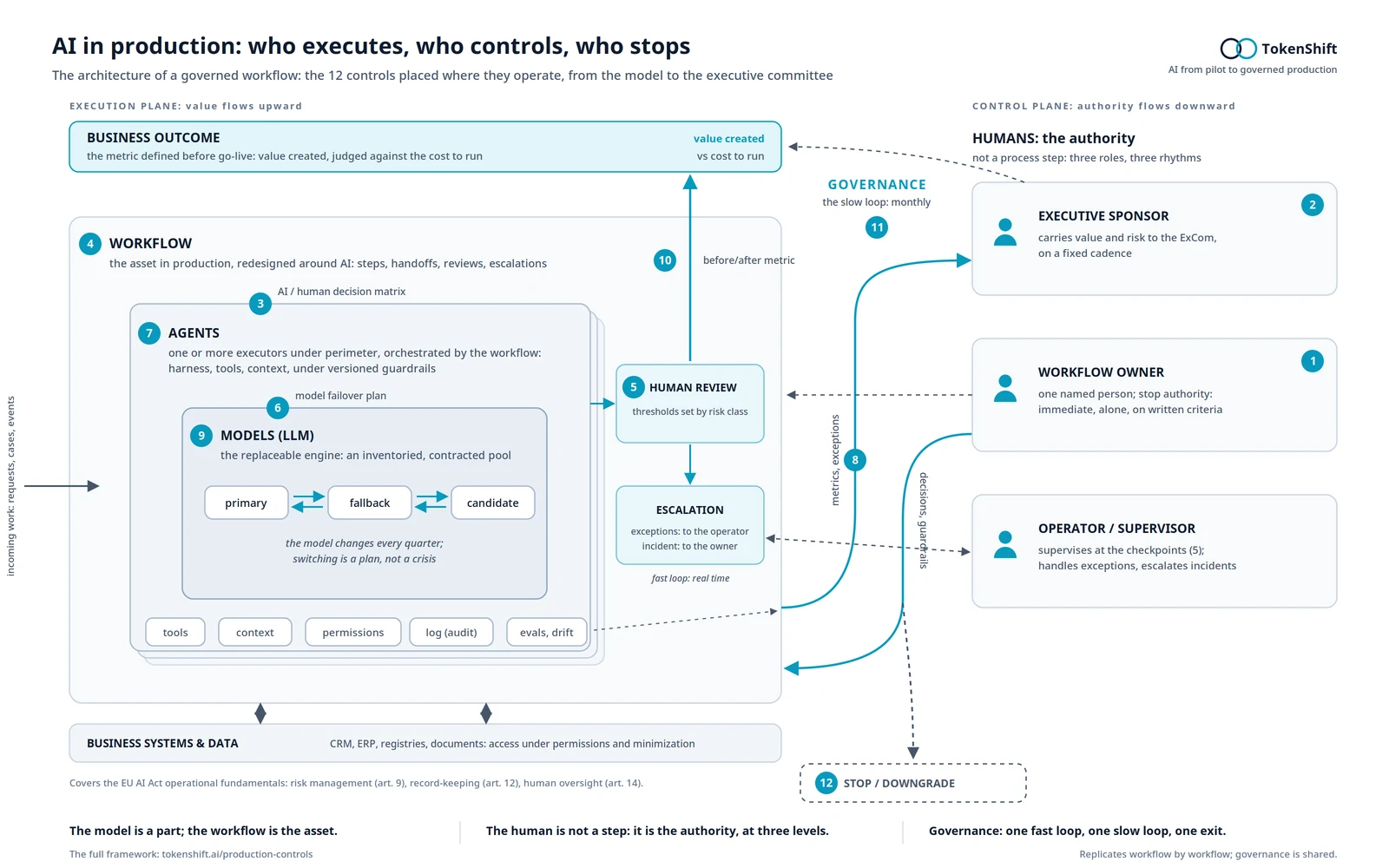
The 12 controls of AI in governed production
In 2026 the bottleneck of enterprise AI is no longer adoption; it is survival in production. Gartner predicts that over 40% of agentic AI projects will be canceled by end of 2027, and that uniform governance applied identically to every agent is itself a failure mode. Field reality matches: beyond a few dozen use cases in production, spreadsheet governance breaks.
This framework states the 12 controls — across four pillars — that decide whether an AI workflow survives model changes, incidents and budget arbitration. It is published openly: use it to audit any production AI workflow in about an hour, with or without TokenShift.
Ownership & accountability
Production AI fails first as an accountability problem. These three controls establish who answers for the workflow — before anything runs.
Named production owner
One named person owns the workflow in production — with the authority to stop it, alone, on defined criteria.
The test
Who can halt this workflow today, on their own authority, and against which criteria?
Fails when
Ownership sits with a committee, or stays with the data science team that built the pilot.
Executive sponsor chain
Value and risk for the workflow reach the executive committee on a fixed cadence, through a named sponsor.
The test
When did the executive committee last see this workflow's numbers — value and incidents together?
Fails when
Reporting stops at the innovation lab, and the board discovers the workflow through an incident.
AI/human decision matrix
An explicit, written record of which decisions the AI proposes, prepares, or takes — and which remain human, whatever the model can do.
The test
Show the decision this system is not allowed to take, and where that is written.
Fails when
Autonomy grows silently with each model upgrade, because no document says where it stops.
Workflow & execution
A model does not go to production; a workflow does. These controls make sure the workflow was actually redesigned to hold the load.
Redesigned target workflow
The production workflow is redesigned around the AI — handoffs, review points, escalations — not the old workflow with AI bolted on.
The test
Which step of the old workflow disappeared? If none did, nothing was redesigned.
Fails when
AI output lands in the same queue as before and creates a review pile that erases the productivity gain.
Risk-tiered human checkpoints
Human intervention thresholds are set per task-risk tier — not uniformly. Some outputs ship unreviewed by design; others never do.
The test
Which outputs ship without human review, and what makes that safe?
Fails when
One rule applies everywhere: 100% review (production theater) or 0% review (unmanaged autonomy). Uniform governance across agents is a documented failure mode.
Model failover plan
A documented procedure for model change, degradation, outage, or discontinuation — with tested alternatives for the workflow's critical steps.
The test
Your provider retires this model in 90 days. What happens tomorrow morning?
Fails when
Prompts, evaluations and integrations are welded to a single vendor's model, and every model update is an unplanned migration.
Guardrails & risk
Guardrails only govern if they exist as artifacts — versioned, reviewed, and connected to what actually happens in production.
Versioned guardrail library
Input rules, output rules, access perimeter and refusal behavior exist as a versioned artifact — v1 before go-live, with a change history.
The test
Show the guardrail file and its last three changes.
Fails when
Guardrails live in people's heads, or only inside a prompt that anyone can edit without review.
Exception review loop
Every guardrail breach is logged, reviewed and classified. Recurring exceptions change the guardrail or the workflow — visibly.
The test
How many exceptions last month, and what changed as a result?
Fails when
Exceptions are silently retried or absorbed by operators, and the guardrail decays into decoration.
Model & vendor register
An inventory of models, versions, dependencies, contractual terms and exit conditions — for every model the workflow touches.
The test
Which model versions are running in production right now, under which contract?
Fails when
Nobody can answer without asking the vendor — which means the vendor holds the register, not you.
Value & operating rhythm
What is not measured before go-live cannot be proven after it. These controls keep value, risk and the exit honest.
Before/after business metric
The business metric the workflow must move is defined and measured before go-live. Every value claim traces back to it.
The test
What was the number before? Who measured it, and when?
Fails when
Value is asserted through usage statistics. Adoption is not impact.
Monthly governance rhythm
A fixed monthly review holds the line: value, adoption, exceptions, vendor and model changes, and the next workflow decision.
The test
Show last month's minutes and the decisions taken.
Fails when
Governance happens as an annual audit or as incident response — always after the fact.
Kill and downgrade criteria
The conditions under which the workflow is downgraded, paused or decommissioned are agreed before go-live — with the owner empowered to apply them.
The test
Which result, over which period, triggers a stop — and who signed that?
Fails when
Sunk cost decides, or an incident does. Analysts expect a large share of agentic deployments to be downgraded after production incidents reveal exactly this gap.
How to use this framework
Take one workflow in production — not the portfolio. Score each control as present, partial, or absent, using the test question as written. The audit takes about an hour with the workflow owner and one operator.
Three controls are absent in most deployments we see: the AI/human decision matrix (3), the model failover plan (6), and kill criteria (12). Start there.
The framework maps to the TokenShift delivery path: Decision Clarity installs controls 1-3 and 10, a Production Sprint installs 4-9, and the Governance Retainer runs 11-12. But the controls stand on their own — they describe what governed production means, not what TokenShift sells.
Your process is outsourced to a BPO? Part 2 places the 12 controls on the contract boundary.
The 12 outsourced-AI controlsWant the audit run for you?
Decision Clarity applies these controls to one priority workflow and returns a board-ready decision in 4-6 weeks.
Talk about your priority · 20 min