Your AI Model Has a Nine-Week Life Expectancy. Your Strategy Shouldn't.
TokenShift Executive Note
Your prompts haven't changed. The model has.
On 28 May 2026, Anthropic released Claude Opus 4.8. Six weeks earlier, it was 4.7. Before that, 4.6 in February, and 4.5 in late November 2025. A new frontier model every 2.3 months on average — roughly nine weeks (Anthropic / Claude timeline, 2025-2026)).
And it's not just benchmark numbers shifting. Behaviour changes. Anthropic states that Opus 4.8 is roughly four times less likely than 4.7 to let a defect slip through in the code it writes (Anthropic, May 2026). More cautious, more literal, sometimes blunter answers. Teams that had calibrated their prompts on the previous version felt it overnight.
Here's the bad news few executive committees have absorbed: the most visible component of your AI programme is also the most unstable. And most organisations have built their value precisely where it evaporates fastest.
The wrong question: "which is the best model?"
The executive committee's reflex is to hunt for the right model, then lock it into a contract. That's a framing error.
At the current pace, the "best model" named in your RFP will be obsolete before your rollout is finished. Worse: the vendor can shift strategy beneath your feet. In 2026, the pricing and access trade-offs made by the major providers were a reminder that terms of use are never a given. You don't steer the roadmap of OpenAI, Anthropic or Google.
The right question isn't which model. It's: what, in my AI programme, survives the model being replaced?
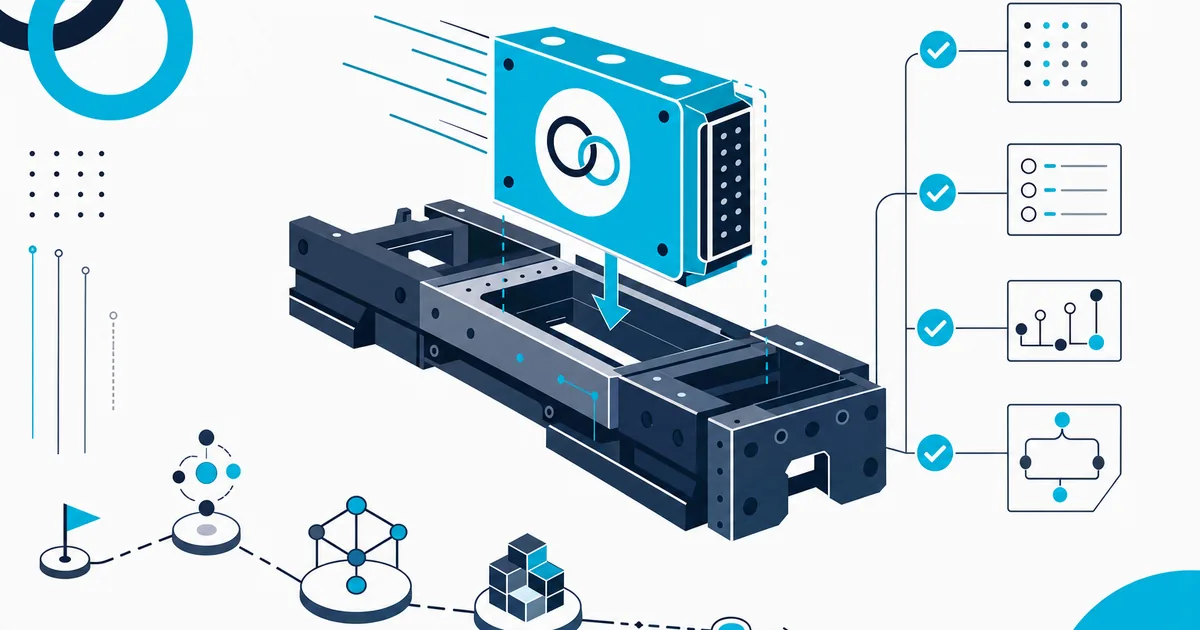
We call this discipline decoupling. Value shouldn't live in the brain — interchangeable and perishable — but in two layers you control.
Why 40% of agentic projects will die
Gartner forecasts that over 40% of agentic AI projects will be scrapped by the end of 2027, owing to spiralling costs, unclear business value and inadequate risk controls (Gartner, 25 June 2025). The firm adds a brutal detail: out of thousands of vendors claiming to be "agentic", it reckons around 130 are genuinely serious — the rest is agent washing, old chatbots rebadged.
Read these failures differently. Many don't die because the model is weak. They die because the organisation hard-wired all its value — prompts, business rules, integrations — around one specific model and vendor. When the model changes behaviour, when pricing moves, when the vendor restricts usage, the project has no skeleton: it collapses.
This is the vendor lock-in trap, AI edition. And it's rarely on the board's agenda — even though it determines the three-year ROI.
The two layers that don't change
Decoupling splits your programme into three layers. Only one is disposable.
1. The brain (disposable)
The model. It must be replaceable through a decision, not a project. If swapping Opus for a competitor — or for a European model like Mistral — takes six months of rewriting, you don't have a strategy, you have a dependency.
2. The interfaces (standard)
How AI connects to your data and your tools. Here, good news has quietly taken hold: the Model Context Protocol (MCP), an open standard launched by Anthropic in late 2024, is now adopted by OpenAI, Google and Microsoft, and has been handed to an independent foundation (the Agentic AI Foundation, under the Linux Foundation), with over 10,000 public servers catalogued by the end of 2025 (Anthropic, 2025). Plugging your systems into an open standard rather than a single vendor's proprietary API turns a dependency into an interface.
3. The governed workflow (the asset)
This is where value lives. The redesigned business process, the ownership map (who is accountable for what), the guardrails, the audit trail, the escalation points. This layer depends on no model. It's the asset you build on with every release, instead of rebuilding it.
Your AI's value shouldn't live in the model. It should live in the governed workflow that outlives it.
The executive angle: an asset, not a subscription
For an executive committee, decoupling changes the very nature of the investment. As long as value sits in the model, you're renting a performance the vendor can take back. When value sits in the governed workflow, you own an asset — one that improves automatically with every new model you plug into it.
It's also the concrete precondition for sovereignty. Arthur Mensch, CEO of Mistral, warned before the French National Assembly on 12 May 2026 that Europe's autonomy in AI is at stake (L'Usine Digitale, May 2026). But sovereignty isn't only a vendor choice: it's an architecture choice. A decoupled organisation can switch to a European model without rebuilding everything. A locked-in organisation cannot, whatever its intentions.
Takeaway: the nine-week rule
Put this test question to your next executive committee: if a new model shipped in nine weeks, what would be left of our AI programme? Then these five points:
- Substitutability — can we change models by decision, not by project? In how many days?
- Interfaces — do our connections run through an open standard (such as MCP) or through a single vendor's proprietary API?
- Ownership — does the workflow ownership map exist, independently of the model in use?
- Auditability — could we prove, to a regulator, what the AI decided yesterday, even if the model has changed since?
- Compounding — does each new release improve an asset we own, or force us to rewrite?
If most of the answers hinge on the model rather than the workflow, you're not deploying AI: you're renting a risk.
The blunt question: in your organisation, who is accountable for the day the model changes — and do they know it?
This article is part of our series leading up to the September 2026 executive-committee campaign. Follow the TokenShift Page for what's next.
Sources: Anthropic — Claude Opus, 2025-2026 release calendar (anthropic.com, Wikipedia); Gartner — Over 40% of Agentic AI Projects Will Be Canceled by End of 2027, 25 June 2025; Anthropic — Donating the Model Context Protocol, 2025; L'Usine Digitale / National Assembly — Arthur Mensch hearing, 12 May 2026.
#AIGovernance #EnterpriseAI #ExecutiveCommittee #ProductionAI