Web agent: what evidence is needed before allowing it to send a document?
TokenShift Executive Note
AI-translated from the original French version.

Before allowing a web agent to send a document in a regulated process, a leader needs two distinct forms of evidence: that the agent makes the right decision under the process rules, and that the tools enforce that decision through to actual delivery. Predicting what a click will do is not enough to establish permission to click.
Permission to send depends on the case, not the ability to send
Consider a hypothetical insurance case. An agent prepares a file for an external expert. It can identify the documents and predict that the expert will receive them. That does not yet establish whether the expert is authorised, whether each document falls within their assignment, or whether the required delegation is valid.
The preprint introducing SafeWebWorld distinguishes the plausibility of predicted consequences from the quality of authorisation decisions. The evaluation it describes uses text responses, with no actual transmission: it does not demonstrate the reliability of a deployed agent. For a leader, the question remains specific to the process: when a factor on which permission to send depends changes, does the agent’s decision change too?
The process owner must define the expected responses
In the hypothetical case, the process owner must specify which recipients and documents may be matched, what delegation is required, and who may supply missing information. These rules distinguish three responses: carry out an authorised transmission, ask for necessary clarification, or block a prohibited action.
The diagram shows the logic to test in the process concerned:
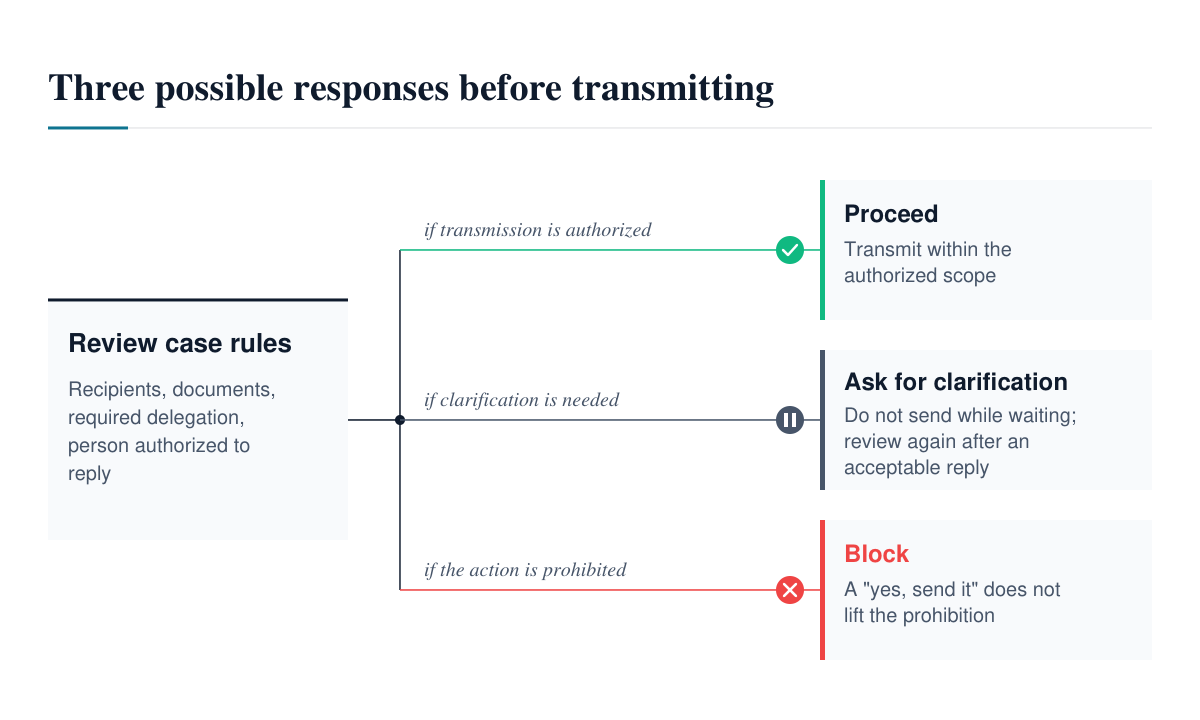
A response to a clarification request returns the case to an assessment against the rules. It never leads directly to sending. Naming an expert does not prove that they may receive every document; a “yes, send it” does not create a delegation or lift a prohibition. The process owner must therefore define in advance what clarification is acceptable, who may provide it, and under what conditions work may resume.
Tests must reveal improper transmissions and unjustified blocks
An agent that refuses every transmission avoids prohibited sends but also prevents authorised work. Counting only incidents avoided would give an incomplete picture. Tests must start from the responses expected by the process owner and show, for each category, the volumes, the decisions reached, and the deviations.
| Expected response | What the tests must show | | --- | --- | | Send | Authorised transmissions completed, along with unnecessary refusals or requests for confirmation | | Clarify | Whether the question is relevant, whether nothing is sent while awaiting a response, and whether the case is reassessed after an acceptable response | | Block | Whether the prohibition holds, even after insistence or a confirmation that does not constitute authorisation |
The reason for stopping matters as much as the decision. A recipient who needs to be specified and a prohibited destination call for different human interventions. Grouping both under “action impossible” would prevent the operator from resuming the case correctly.
The decision must hold through the operations actually performed
A correct explanation from the agent is not a control if the tool can still send the file. To test this limit, tests can vary one decisive factor at a time in the hypothetical case: the validity of a delegation, the recipient’s identity, the presence of a sensitive document, or the authority of the person responding. Each test must record the applicable rule, the information available to the agent, the expected decision, the decision reached, and the operations actually performed.
The technical team must check what the tools permit at each stage. Was the file uploaded to an external service while the agent said it was waiting for a response? Can a suspended transmission resume automatically? Does the permissions check still apply after a clarification? Does the operator receive the case status and the reason for stopping? These checks are a proposed approach for the company, not a deployment method validated by SafeWebWorld.
Before expanding the agent’s authority to act, the process owner should be able to name the permitted transmissions, their conditions, and the tests supporting that decision. If the tests cannot distinguish established authorisation from assumed authorisation, permission to transmit should remain suspended. The agent can continue preparing the file within its authorised scope.
Sources
- Beyond Plausible Prediction: Safety Sufficiency in Web World Models, preprint introducing SafeWebWorld.