The Interpretation Layer: What Your Experts Know That No Process Documents
TokenShift Executive Note
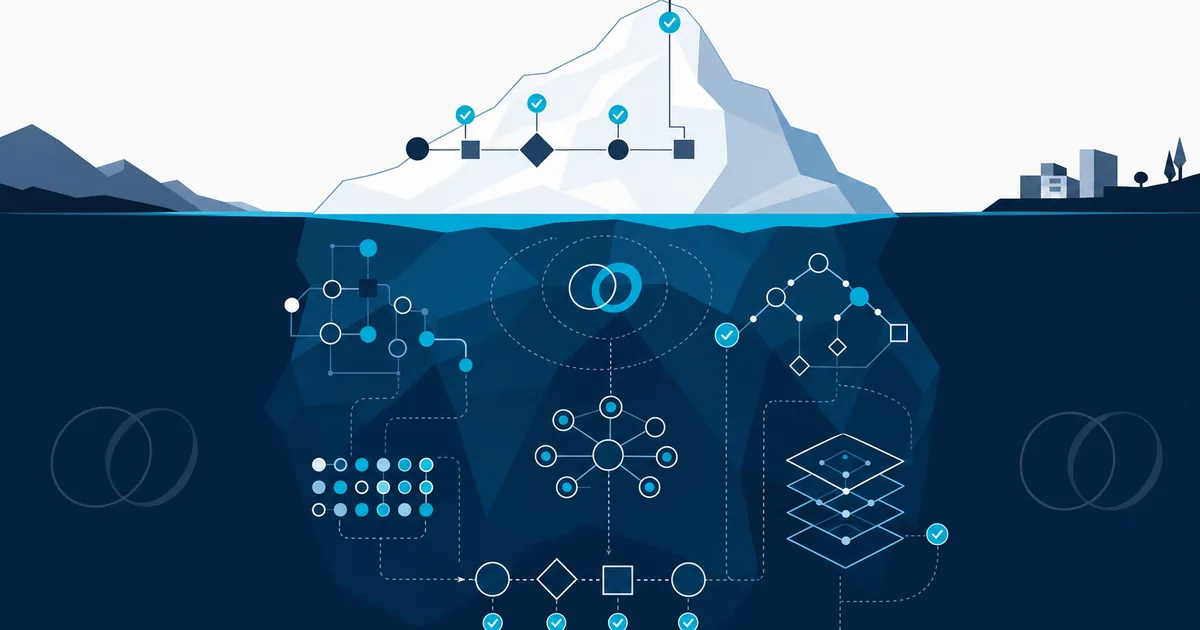
In early 2026, a directive comes down from the top of a company: add AI to the contract-review workflow. Not a pilot, not an experiment — a decision. On paper, the process is crystal clear: contracts come in, they're checked against a clause checklist, flagged items go up to legal. The technical team wraps up scoping in a week. PDF ingestion, clause extraction, detection: the hard part is solved. A few weeks later, legal has stopped using the system and is calling the former point person directly. This account, shared by a practitioner, describes the most expensive blind spot in enterprise AI.
The written workflow is not the real workflow
The person who had run contract review for three years wasn't checking clauses. She was the interpretation layer between suppliers and legal. She knew which supplier generated recurring noise, which flag genuinely warranted an escalation, which clause that was "non-compliant" on paper had in fact been a tolerated practice for two years. None of that appeared in any process document. It was a second job nested inside the official one — invisible right up until the day someone tried to automate it.
This is the point most AI programs miss. When you automate a workflow, you're not automating the real work: you're automating its documented version. The process document captures the visible mechanics; it never captures the accumulated judgment that decides what matters. That interpretation layer is what turns an accurate output into a usable decision. Automate without mapping it, and you produce a workflow that's faster and more wrong.
The easy part was the tech. What breaks is the context handoff nobody had ever written down.
The signature of an interpretation-layer failure
This failure has a recognizable signature, and it doesn't look like an outage. The agent works. Extraction is clean. And yet the volume of escalations climbs while their quality drops. In the account, legal started pushing back on flagged items: not wrong, just stripped of the reading a human would have added. Within a few weeks, the downstream team routed around the system and went back to the old way.
Three observable markers give the problem away before it ever surfaces at the executive committee:
- Throughput goes up, downstream acceptance goes down. You produce more escalations, and the receiving team keeps a shrinking share of them.
- People route around the system. Downstream reaches back out to the former point person directly. This is the most reliable signal that an interpretation layer was destroyed, not transferred.
- Nobody can say why the agent escalated a file. The absence of a rationale stands in for a rationale.
This dynamic partly explains the macro numbers. Gartner predicts that over 40% of agentic AI projects will be scrapped by the end of 2027, driven in part by unclear business value and inadequate risk controls (Gartner, June 25, 2025). On the ground, the share of companies abandoning most of their AI initiatives rose from 17% to 42% in a single year, and 46% of proofs of concept are dropped before production (S&P Global Market Intelligence, VotE AI & ML, Oct. 2025, n=1,006). A meaningful slice of that mortality isn't technical: it's context that never got transferred.
Map the tacit before you automate
The good news: the interpretation layer can be mapped. It calls for a different approach than the one used to write the process document, because it questions the person, not the procedure.
- Interview the point person, not the process doc. Reconstruct the unwritten rules: which supplier generates noise, which flag is a real escalation, which non-compliance is in fact tolerated.
- Label a historical sample with them. Across 100 past files, have them annotate the decision made and the reason for it. That gives you the material the process never recorded.
- Explicitly separate the two layers. Extraction (reading, comparing, detecting) can be automated. Interpretation (deciding what warrants an escalation) has to be codified or kept human — not assumed away.
- Build the handoff layer. The agent shouldn't just produce an output: it should produce the output plus the context that makes it usable downstream. This is the part the account calls under-built, and it's where adoption is won or lost.
- Keep a human in the loop as the interpretation step. Measure accuracy before you remove the person, not just speed. Gartner notes, for its part, that the rise of agentic AI makes human oversight more indispensable, not less (Gartner, June 2025).
Mistakes to avoid
- Mistaking the documented process for the real one. This is the parent error; every other one follows from it.
- Measuring throughput instead of accuracy. Counting escalations produced instead of the rate of escalations accepted downstream is celebrating a counter while value collapses.
- Treating the domain expert as a cost to cut rather than a source to interview. Their value isn't in the hours they log — it's in the escalations they know not to raise in the first place.
- Shipping the easy part and under-investing in the handoff. Ingestion and extraction impress in a demo; the handoff layer decides whether downstream adopts or routes around it.
- Removing the human before proving accuracy. Speed without accuracy produces exactly the pattern observed: more escalations, less trust.
What this changes for an executive committee
On the same Tuesday morning, two companies launch the automation of a file-review process. The first measures files processed per hour and unplugs the expert the moment it goes live. The second measures the rate of escalations accepted downstream and keeps the expert as the interpretation step until accuracy is proven. Six weeks later, the first has a system nobody uses; the second has cut its processing time with no rise in rejections. Same technology, two outcomes, one difference: was the interpretation layer transferred, or destroyed?
For your next committee, four questions are enough to stress-test an automation project:
- Who holds the interpretation layer for this workflow today, and did we interview them before scoping?
- Are we measuring downstream acceptance, or only the volume produced?
- Does the agent's output carry the context that makes it usable, or just the result?
- Are we already seeing workarounds — that signal that downstream no longer trusts the system?
A project that can't answer those four questions clearly isn't ready for production. It's ready to be routed around. And routing around isn't neutral: when downstream falls back to the old method, legal liability for the AI's outputs still sits with the company.
TokenShift helps leaders move AI from pilot to governed production: explicit ownership, guardrails, a governance cadence, measurable results.