Our content is produced by AI agents. Here's why we're telling you, and how we govern them.
TokenShift Executive Note
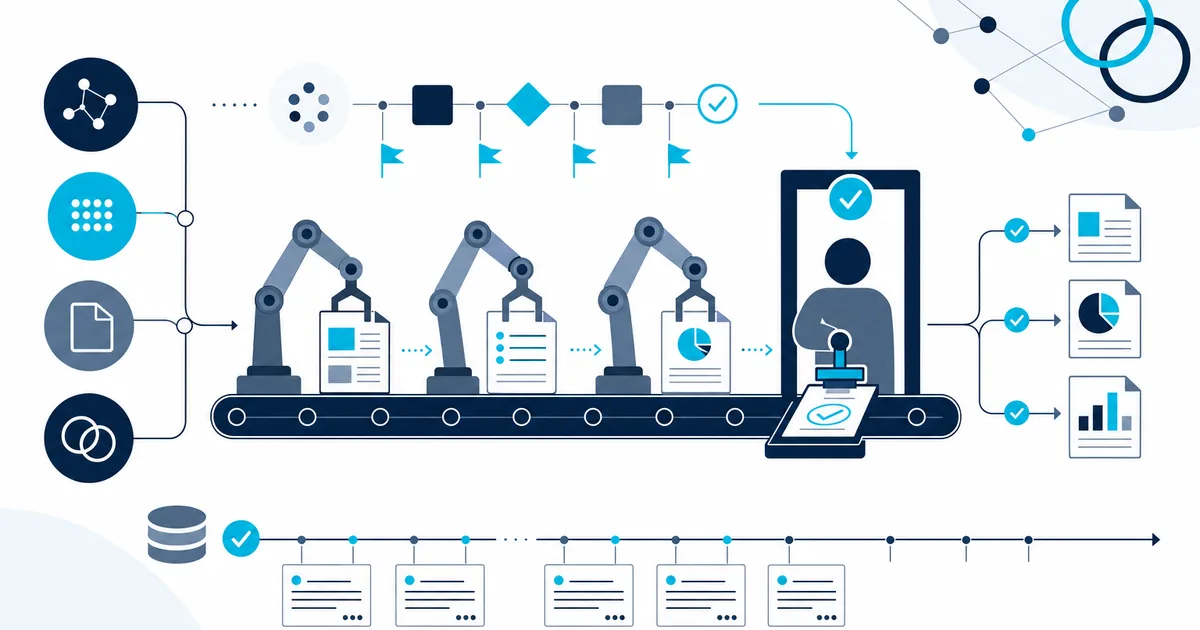
This article was prepared by an AI agent. A human reviewed it, requested the corrections they judged necessary, then approved it for publication. That sentence is not a confession: it's a demonstration. Because the subject of this article is precisely the system that produced it.
At TokenShift, we help regulated companies move AI from pilot to governed production. The most credible advice is the advice you apply to yourself. So our own editorial output runs exactly the way we recommend running any enterprise AI workflow: agents that execute, a human who decides, an audit trail that records everything.
What the machine does, and what it never does
Our editorial pipeline runs continuously across several servers. Every day, agents gather intelligence (news feeds, specialist newsletters, video analysis), rank it by relevance, and store it in a structured knowledge base. From that raw material, other agents draft articles, generate an illustration in the visual identity of the site in question, and prepare the distribution variants: LinkedIn post, newsletter teaser, quote graphic.
Then everything stops at a single gate: human validation.
No content ships until a named person has clicked "Approve." The validator receives the complete article, illustration included, with two possible actions: approve it for publication in the next slot, or request a rewrite with their instructions. If they don't act, nothing ships. Silence is never consent.
This is the first principle we bring to our clients: an agent's autonomy is defined by what it cannot do on its own. An agent that drafts is useful; an agent that could publish on its own would commit our brand without a mandate.
The execution mandate applied to ourselves
In our engagements, we set out an execution mandate for each agent: scope, identity, escalation point, traceability. Our editorial pipeline applies all four.
- Scope. Each agent has a bounded role: gather, draft, illustrate, publish to the slot. None does all four. The publishing bot knows how to do exactly one thing: publish an already-approved article, in the scheduled slot, on the intended site.
- Identity. Agents act under dedicated technical accounts, not under a person's identity. Every action is signed and revocable.
- Escalation point. An irreversible action (publishing, sending a newsletter) requires explicit human validation. Rewrite requests loop back into the machine; the decision to publish never does.
- Traceability. Every article carries its audit file: who approved it, when, what was published, where, through which channel. In case of doubt, we can replay the full history of a piece of content, from the source in our intelligence feed to the published URL.
What this system has taught us
Running this pipeline teaches us every week what the slides never show.
Cadence beats volume. A system that publishes twice a week without ever missing a slot builds more credibility than a burst followed by three months of silence. Discipline is a deliverable: when a publishing queue is about to run dry, the system generates drafts ahead of time and alerts the validator, rather than letting the slot go to waste.
Quality is governed in a loop, not in a single shot. Every rewrite request is kept. Once a month, the system aggregates those instructions: whatever comes up twice becomes a generation rule. The human corrects the same flaws less and less, because the system learns from its corrections.
AI should propose, the human should stay the author wherever it's their voice. Our expert content is produced by agents and validated by a human. But personal, first-person pieces follow the reverse rule: the machine supplies facts, the human writes. The day everything starts to sound alike, we've lost the very thing that makes you worth reading.
Why we're telling you
Because transparency is the precondition for trust, and because the European AI Act is turning it into a growing obligation for generated content anyway. But above all because this system is our best proof: we don't sell a theory of AI governance, we operate one, every day, with real brand and reputation on the line.
If you're wondering what one of your workflows would look like in governed production, the answer fits in a single sentence: agents that execute fast, a person who always decides, and an audit trail that forgets nothing. That's exactly what we build with our clients, one workflow at a time.
TokenShift works with the executive committees of regulated companies to move AI from pilot to governed production: scope, ownership, guardrails, and governance cadence.