AI ROI: who holds the budget, and who should answer for the result
TokenShift Executive Note
AI-translated from the original French version.

Today, nobody answers for AI ROI, because paying, measuring and stopping fall to different people. The head of AI sees which use cases work, but spending is decided elsewhere: according to the IBM Institute for Business Value, only 18% of AI leaders say they have full control over investment decisions.
That is the finding. Our answer to the second question is a recommendation: the person who should answer for the result is the business leader who stands to capture the gain. For each use case, that person should hold the budget, the measurement and the right to stop together, even if this means moving the budget, for example from IT to the sales function.
The person who sees performance does not decide spending
Separating the roles has a direct effect: the signal exists, but the decision lags. In the IBM survey of 1,667 executives responsible for AI in 33 countries, only 29% of respondents see their organisation quickly adjust decisions and resources when metrics point to a possible improvement; for 40%, the issue is discussed, then action lags. And only 31% consider it essential to set clear thresholds for stopping an initiative: even among those who track performance, the stopping criterion is not a priority for the majority.
Spending, meanwhile, sits mostly outside the technical perimeter. According to the BCG Applied AI Index published on 30 September 2026, it rose from about 1.7% to 3.3% of revenue in one year, and more than 80% of it sits outside corporate IT. For an executive committee, this means rising budgets spread across many functions, and a head of AI who can flag that a use case is disappointing but, in most cases, cannot decide alone to renew its funding or shut it down.
Without a commitment to a result, time saved takes its place
Since the person paying has committed to no result, they still need to present something when the spending comes up for renewal. So they present what is easiest to measure: time saved.
The UK government's experiment supplies the most widely quoted figure: 26 minutes saved per day, across 20,000 civil servants in twelve organisations, over three months in late 2024. The gain is self-reported by participants, and what became of the freed-up time is unknown. The figure tells you about how the tool is used and how its users perceive it, not about a result.
The difficulty lies in what the figure is then made to say. In the investment committee, these minutes become "business value" that nobody has to defend, since nobody has committed to finding them again in revenue, cost or lead time.
Time saved does not find its own way into the accounts
These minutes might be enough if they converted mechanically into results. That is not what we observe. In McKinsey's The State of AI in 2026, 80% of respondents say AI has improved their productivity, and only 37% say it has contributed positively to their company's operating profit.
Two field studies show where the gain stops. Generative AI at Work, a study of 5,179 customer support agents, measures an average 14% increase in issues resolved per hour, rising to 34% among novice or lower-skilled agents. In this job, individual output is counted directly: the time an agent saves is already a result. The Microsoft Research field experiment, conducted with 7,137 employees at 66 companies, covers office work that depends on other people. Regular users spend two fewer hours a week on email, with no significant fall in time spent in meetings and no detected change in the quantity or mix of their tasks. Two hours are freed up, but the work produced stays the same: nothing extra reaches the accounts.
Our reading of these two studies side by side is this: the gain appears where one person can change how they work on their own. Meetings, approvals and review by a third party do not shift by themselves; changing them is an organisational decision. Yet neither the head of AI nor IT has authority over another function's calendars, approval circuits or objectives. The leader of that business does. But as long as the tool is paid for from another budget and nobody asks what it delivers, the freed-up time costs that leader nothing and nothing obliges them to reorganise their team. They only have a reason to do so if they pay for the tool and answer for what comes out of it.
Budget, measurement and the right to stop must sit with the same business owner
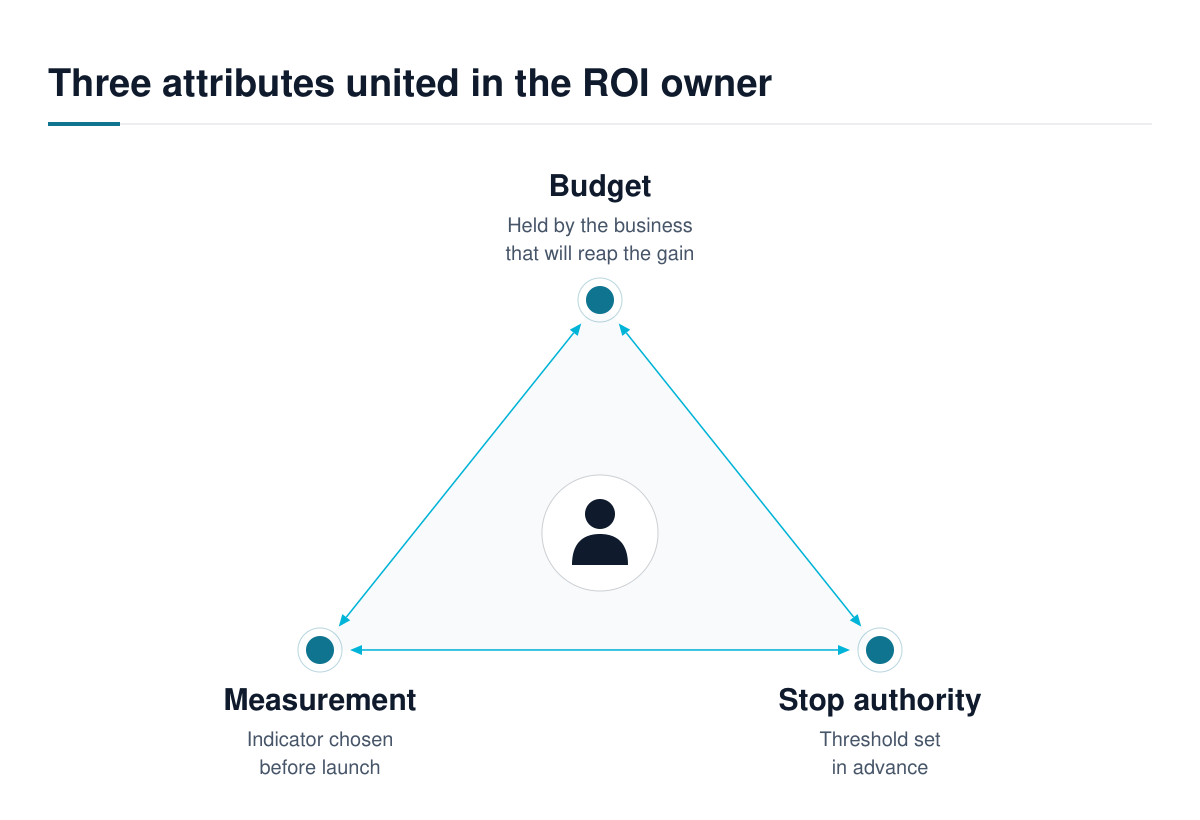
If converting time saved depends on a business decision, the business is where the result must be demanded. Each use case then gets an ROI owner, drawn from the function that will capture the gain, who holds the budget, the measurement and the right to stop together. This recommendation follows from the diagnosis: the surveys describe how dispersed the roles are; they do not test this remedy. What it does guarantee is that the question of results has someone to answer it, which is the precondition for checking whether it works in your own organisation.
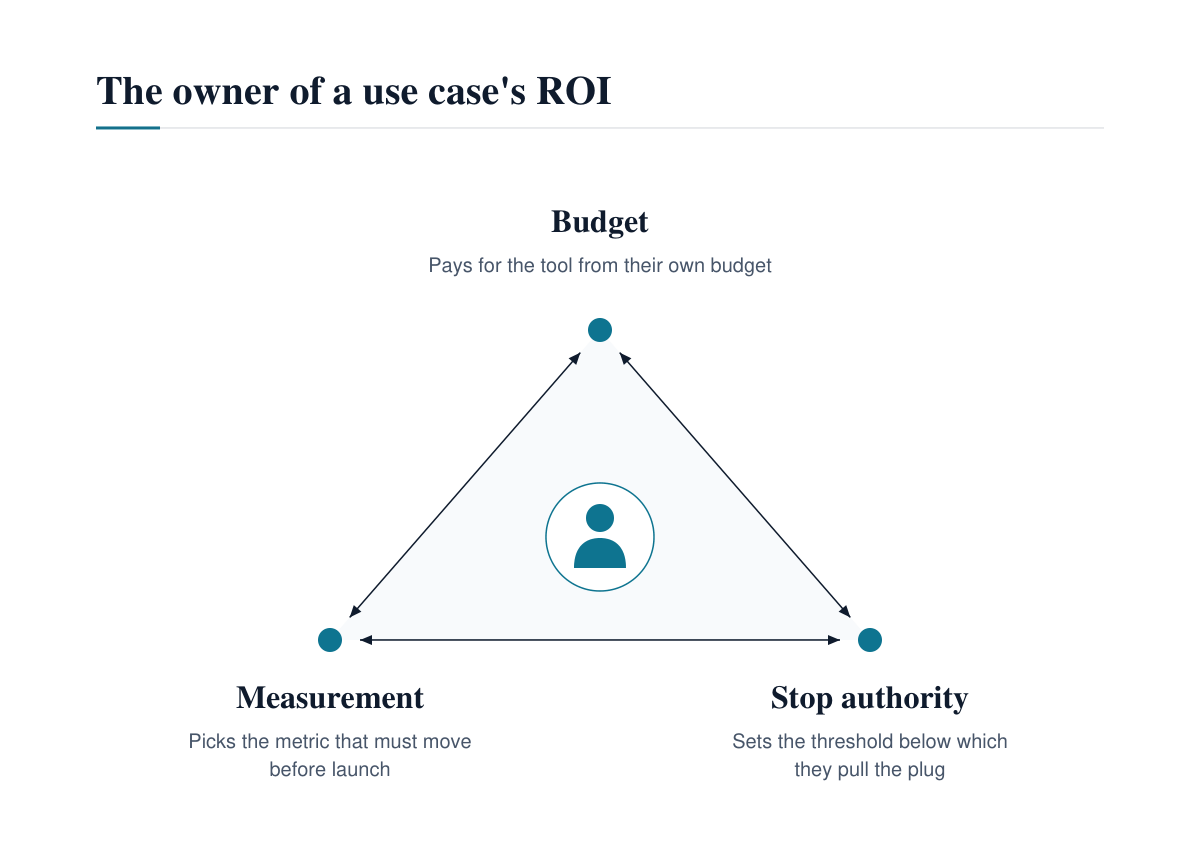
Take a hypothetical example. A sales function equips its reps with an assistant that prepares meetings and writes up meeting notes; suppose each rep saves half an hour a day. As long as the budget sits with IT, measurement with the AI team and the revenue target with the sales director, nobody has to say what becomes of that half hour. Now move the budget to the sales director. They pay for the tool, they chose before launch the metric that must move (for example, the number of client meetings per rep) and the threshold below which they cut it. The question now has someone to answer it, and that person is also the one who can reorganise calendars so that the freed-up time goes to clients.
The three attributes only work together. Whoever holds the budget without the measurement renews spending on the strength of a usage dashboard. With measurement alone, you document a failure you cannot correct. And a right to stop without a threshold set in advance risks never being exercised, especially against a project sponsored by an executive.
The head of AI keeps a role: they provide the measurement method, compare use cases with one another and raise the alarm. They do not answer for a business function's results in that function's place.
One name against each use case
Today, the AI budget is held by one person, measurement by another, and the right to stop by a third or by nobody, which is why no one answers for the result. The person who should answer for it is the business leader who captures the gain, because only they can reorganise work so that freed-up time becomes revenue, cost or lead time.
Start with the use cases that are already funded rather than new ones. For each, ask three questions: who pays, who measures, who can stop it and at what threshold. Three different names, or an empty box, point to a use case nobody will answer for; a single name tells you whom to ask for the result. And until that name exists, do not renew any budget on the strength of minutes saved alone.
Sources
- IBM, press release on the IBM Institute for Business Value and Oxford Economics study of Chief AI Officers: prnewswire.co.uk
- McKinsey, The State of AI: mckinsey.com
- BCG, Applied AI Index, press release of 30 September 2026: bcg.com
- UK government, Microsoft 365 Copilot Experiment: Cross-Government Findings Report: gov.uk
- Brynjolfsson, Li and Raymond, Generative AI at Work, NBER: nber.org
- Microsoft Research, field experiment on generative AI at work: arxiv.org