40% of AI agent projects will be scrapped — and the model isn't to blame
TokenShift Executive Note
For two years, the boardroom debate has been about picking the right assistant: which model, which copilot, which vendor. That was the right question for 2024. It is fast becoming the wrong one.
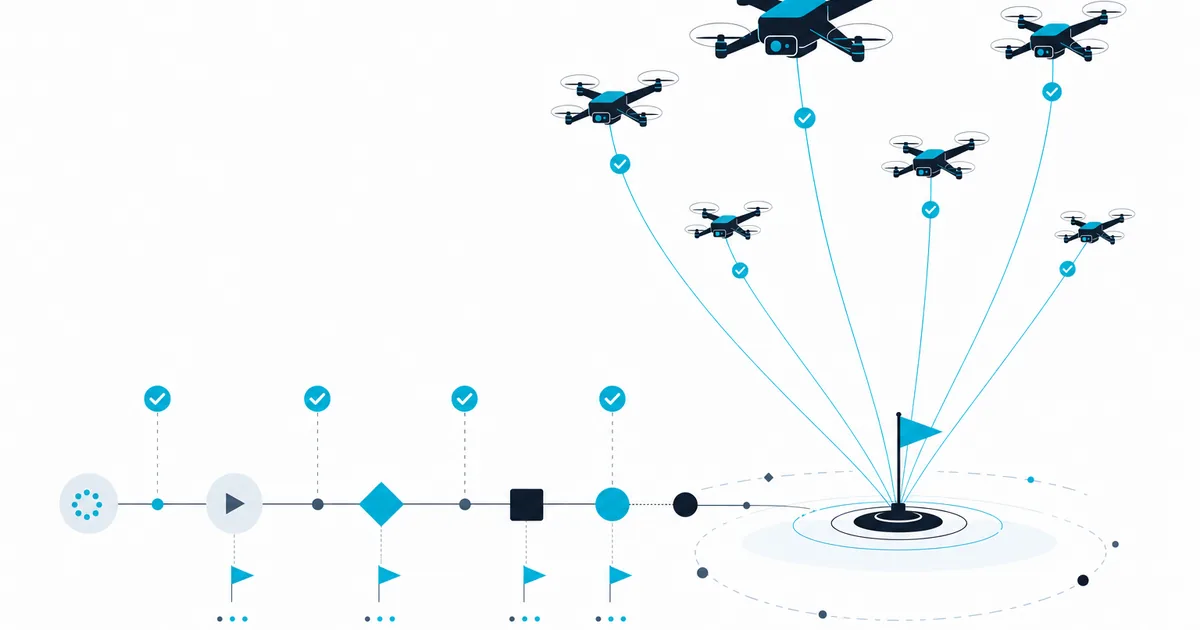
eToro founder Yoni Assia claims that the majority of the world's money will be managed by autonomous agents within twelve to eighteen months. An investor's prediction — take it for what it is. But beneath the provocation lies a structural fact: we no longer deploy one assistant that a human talks to. We deploy fleets of agents that act on your systems, with no human at every step.
And on 25 June 2025, Gartner delivered the verdict: more than 40% of agentic AI projects will be canceled by the end of 2027, owing to runaway costs, fuzzy value, and inadequate guardrails.
Read that last part closely. This is not a model problem. It is a control problem.
The unit of governance has changed scale
For two years, the unit of AI governance was the prompt: a human asks a question, reads the answer, decides. Oversight was implicit — someone was in the loop at every interaction.
An agent breaks that contract. It fires off actions in series, calls tools, writes to your databases, pays, follows up, escalates — while you sleep. This is precisely what the most advanced use cases describe: agents that divide tasks among themselves, write code, test it, and fix the bugs autonomously, steered by a handful of instructions. The fabric that makes this possible already exists: Anthropic's Model Context Protocol, launched in late 2024, has become the standard for connecting agents to enterprise tools — adopted by OpenAI, Google, Microsoft, and AWS, running at the likes of Block and Bloomberg, and handed over in late 2025 to an independent foundation under the Linux Foundation's umbrella.
Put it in COMEX terms: your agents are wiring themselves into your systems through a standard you don't control, to carry out actions no human reviews one by one.
The right unit of governance is no longer the prompt. It is the agent.
"Agent washing": the trap at the point of purchase
Before you can govern your agents, you first have to know which ones genuinely are agents. Gartner uses a blunt term — agent washing — to describe the relabeling of existing chatbots, RPA, and assistants as "agents," with no real capacity for autonomous action. Its estimate: out of thousands of vendors that lay claim to agentic AI, roughly 130 are the real thing.
This is the buyer's blind spot. A COMEX that signs an "agentic" contract with no exit clause buys two risks in one: a product that doesn't do what it promises, and dependence on a vendor whose scope of action, whose data usage, and whose off-ramp it does not control. The build-vs-buy question is no longer about cost. It is about operational sovereignty.
The agent mandate
An autonomous agent is not a tool. Functionally, it is a colleague acting on your behalf. You wouldn't hire an employee with no job description, no line manager, and no power to dismiss them. Apply the same rigor. We call it the agent mandate — four non-negotiable clauses, in place before anything goes into production.
1. An owner. A named human, not "the AI team." An ownership record that states who answers to the board for this agent's actions. Without an owner, there is no governance — there is theater.
2. A scope. Which systems, which data, which actions, with which ceilings. An agent that can read is not an agent that can write; an agent that can write is not an agent that can pay. Every extension of scope is a decision, not a default setting.
3. A proof. An auditable trail of what the agent decided and did — board-ready, not log-ready. The Air Canada precedent (2024) settled it: the company is legally liable for what its AI outputs. A decision you can't trace is a decision you can't defend.
4. A kill switch. An escalation threshold to a human and a stop button that actually works. An agent you can't halt in production is not an asset — it's an exposure.
An agent with no owner, no scope, no proof, and no kill switch isn't innovation. It's a governance liability that runs itself.
The regulatory clock is working in your favor — use it
On 7 May 2026, the provisional political agreement on the Digital Omnibus pushed back the EU's obligations for high-risk systems: Annex III to 2 December 2027, regulated products under Annex I to 2 August 2028. Many executives will read this delay as breathing room to do nothing. It's the opposite.
This window is exactly the time you need to put a governance cadence in place before your agent fleets reach an unmanageable scale. The 40% of projects Gartner sees being canceled won't die from a bad model — they'll die from having pushed agents into production with no owner, no scope, and no kill switch, then discovering the cost and the risk too late.
Four questions for your next COMEX
- How many agents are acting on our systems today — and which of them have no named owner?
- For each one: what can it write, pay, or trigger without human review?
- Could we, tomorrow morning, prove to the regulator what a given agent decided last week?
- Do we have a tested kill switch — or are we trusting that it'll all work out?
If three of those four answers are fuzzy, you don't have an AI problem. You have a fleet with no mandate.
The question for 2026 is no longer "which agent is best?" It is: who answers for what it does?
So — how many of your agents could you shut down before noon if one of them went off the rails?
---
Sources:
- Gartner, Predicts Over 40% of Agentic AI Projects Will Be Canceled by End of 2027 (25 June 2025) — gartner.com
- Anthropic, Donating the Model Context Protocol and establishing the Agentic AI Foundation (Dec. 2025) — anthropic.com
- White & Case, EU agrees Digital Omnibus deal to simplify AI rules (May 2026) — whitecase.com
- Air Canada precedent (B.C. Civil Resolution Tribunal, 2024) — company liability for its chatbot's outputs
#AIGovernance #EnterpriseAI #COMEX #AIAct #ProductionReady